

Last updated: Aug 11, 2026
You’re not going crazy because your follower count hasn’t increased during the past year; instead, you’re battling an entire infrastructure that has been redesigned while everyone else wasn’t watching. If you were to ask any marketer or creator about their experience of growing on social media in 2026, you would get the same response: “I’m working harder and getting less.” That’s because the system has been redesigned.
Except one. TikTok is still growing accounts from zero to six figures in weeks. Instagram, Facebook, LinkedIn, YouTube, and X have all gotten harder to break through. This blog covers the Sociali Media Growth Challenges behind that gap and what actually works now for organic social media growth.
Most platforms have dropped the follow graph for the interest graph. Content reaches people based on predicted interest, not who follows you.
That shift is the core of every Social Media Growth Challenge creators face today.
Follower count vs watch time used to be a false choice. Now watch time, saves, and shares decide reach far more than follower count does.
TikTok behaves differently because it was built around interest-based discovery from day one.
The creators still growing haven't found a hack. They've just stopped optimizing for the platform of 2020.
For most of social media's history, reach followed relationships. You posted, your followers saw it, and growth meant collecting more followers. That model is functionally dead. Platforms now ask a different question. Instead of "who follows this account," the algorithm asks "who is likely to watch, save, or share this content." A niche account with a few thousand engaged followers can now outperform a broad account with passive ones.
Meta says almost 50% of what shows up in an average Instagram or Facebook feed comes from accounts people don't follow. Old playbooks stopped working because you're not competing for your followers' attention anymore. You're competing against every creator for a stranger's feed. A video watched to completion by 200 strangers can travel further than one liked by 2,000 people who scroll past it. Reach is earned per post now, not banked in your follower count.
Facebook organic reach has continuously declined from 16% in 2012.
Instagram reach dropped about 12% year over year, with posts now reaching 3% to 7.6% of followers.
LinkedIn saw the steepest drop of any platform in a single year.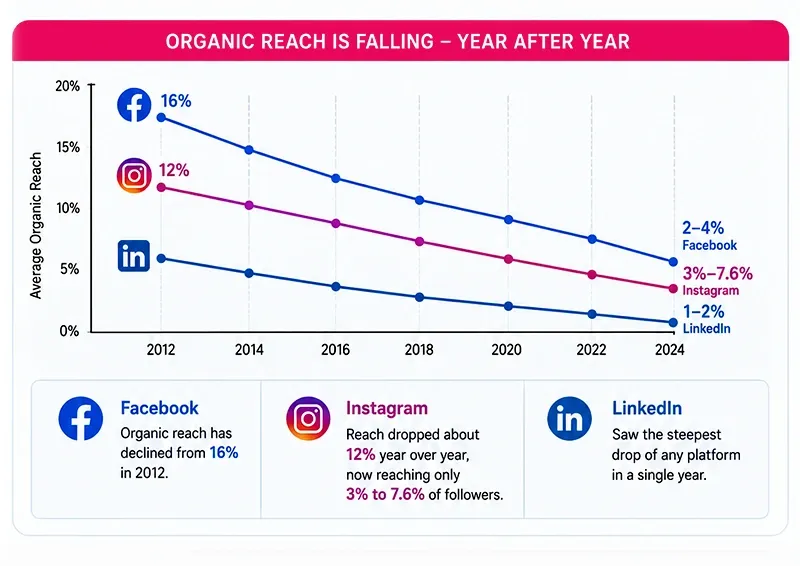
A Part of the process of pulling back by social platforms is deliberate. Platforms earn more when brands pay to be seen. Part of it is simple math: the average user follows hundreds of accounts, all competing for the same feed slots.
Quality control plays a role too. Instagram's originality classifier filters out accounts that repost the same content, cutting their distribution almost entirely. Organic reach vs paid reach isn't a philosophy anymore. It's a budget conversation.
TikTok's For You Page was built around interest-based discovery from its first version. It never had a follow-your-friends era to unwind.
Every other platform is retrofitting interest-graph logic onto an older, follower-based system. That creates friction and creator confusion. TikTok never carried that legacy problem, which is a big part of learning how to grow TikTok organically without an existing audience.
Every new video gets tested against a small pool of a few hundred viewers first. If completion rate and engagement clear a threshold within 30 to 90 minutes, the video graduates to a bigger pool, then a bigger one again.
Follower count barely factors in. TikTok has said outright that neither follower count nor posting history determines whether a video reaches the For You Page. That's the real starting point if you want to get more views on TikTok.
More than any other platform, views and follows are closely linked on TikTok. This is why many creators pay close attention to methods that help them to increase TikTok followers rather than chasing them directly.
Your top-performing videos will continue to get surfaced by the algorithm to new people even long after you upload them. An account with no followers at all can beat an account with 50,000 followers if the video earns strong completion and rewatch rates.
Organic reach on Facebook has deteriorated to the extent that paid reach seems almost mandatory. On TikTok, a good organic video is capable of going viral without having any media spending behind it. It is precisely for this reason that the entire discussion regarding Facebook ads vs TikTok ads has changed so drastically in the last year. Smaller brands are going more for TikTok because organic content still works on the platform.
This does not make things easy for TikTok. Expectations regarding completion rates have increased, and some new developments give slightly more importance to creators who are already established. However, what TikTok manages to do is reward quality content faster than anything else in 2026. That is why the importance of TikTok in social media marketing by brands is truly significant.
The basic concept remains universal: capture attention rather than expect it. All platforms have different approaches to that, and attempting to develop a cookie-cutter social media marketing strategy is the fastest way to stall out.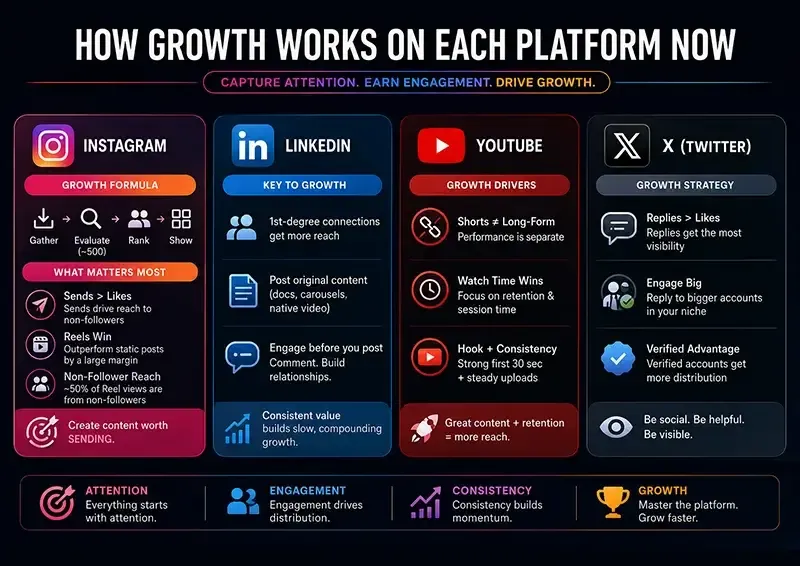
Instagram growth runs a four-stage system. It gathers available posts, evaluates about 500 candidates, weighs signals based on your relationship with the viewer, then assembles a final feed. Watch time, likes, and sends are the top three ranking signals.
The significance of sends in reaching non-following users is huge; therefore, accumulating Instagram followers today means producing content that users want to send, and not just like. Even though Reels have taken a significant step ahead, they are currently outperforming static posts by a large margin. Half of all Reel views are from non-followers.
LinkedIn hasn't fully abandoned the follow graph. First-degree connections still get a real distribution advantage. That's part of why LinkedIn followers grow slowly compared to other platforms. The LinkedIn growth strategy that works in 2026 leans on a few habits. Switch to Creator Mode. Post original documents, carousels, and short native video instead of off-platform links. Comment thoughtfully on other posts before publishing your own.
YouTube has decoupled Shorts performance from long-form performance. A viral Short no longer drags your long-form videos along with it. Ranking is built around watch time relative to impressions, session duration, and satisfaction surveys. Getting YouTube videos in front of new audiences still comes down to fundamentals: a thumbnail that earns the click, strong retention in the first 30 seconds, and a consistent upload rhythm.
X rewrote its ranking system around Grok in early 2026. Replies now carry far more weight than likes. The most effective Twitter growth strategy spends more time replying to larger accounts in your niche than crafting the perfect original post. Verified accounts also see a real visibility advantage in how their content gets distributed.
Every platform sits somewhere between pure social graph and pure interest graph. TikTok sits closest to pure interest graph. LinkedIn sits closest to pure social graph, though it's drifting.
Instagram, Facebook, X, and YouTube all sit in between, and all have moved toward the interest-graph end over the past two years. You're not failing to build an audience. You're failing to earn distribution from an algorithm that no longer cares how big that audience already is.
Chasing followers instead of engagement depth. A large, passive follower base is closer to a liability than an asset now.
Posting the same content everywhere. Platforms detect and deprioritize reposted content.
Optimizing for likes instead of saves and shares. Likes are the weakest signal an algorithm reads.
Giving up too early. Growth compounds, but it often takes two to three months before momentum builds.
Ignoring platform-specific formats. A LinkedIn carousel and a TikTok talking-head video aren't the same content in different outfits.
Lead with retention, not reach. The first few seconds are a gate on every platform now.
Build for saves and shares specifically. Ask if your content gives someone a reason to bookmark or send it.
Treat consistency as a trust signal. Predictable publishing helps algorithms learn who your content is for.
Diversify where you show up. An email list or website means your reach doesn't depend on one platform's next update.
Engage before you post, not just after. This matters most on LinkedIn and X.
Increase engagement organically by asking for the right action. Not "comment YES below," but content structured so saving or replying feels natural.
Paid reach guarantees delivery to a defined audience. Target 50,000 people, and your content gets shown to those 50,000 people. Organic reach offers no such guarantee, even with excellent content. That's part of why brands have shifted budget toward advertising, especially on Facebook, where paid promotion increasingly feels required.
But organic isn't dying everywhere equally. TikTok and YouTube search traffic, to a lesser extent, still offer a real path to scale without a media budget. Treating every platform the same is one of the more expensive mistakes a brand can make in 2026, and it quietly undercuts social media engagement across the board.
AI-driven recommendations are only getting more sophisticated. Platforms are optimizing for satisfaction and long-term habit formation, not isolated engagement spikes. YouTube's satisfaction surveys and Instagram's originality classifier are early signs of the same trend. Platforms want fewer, better pieces of content in front of each user. That's good news if you're building something real. The future of social media looks less like a numbers game and more like a relevance game.
In conclusion, none of this is a reason to walk away from organic growth. It's a reason to stop measuring yourself against a version of social media that no longer exists. Follower count was never the point. It was always a proxy for something harder to fake: attention people chose to give you, more than once. That's still available in 2026. It's just earned differently now, post by post, save by save, watch by watch. A smart creator with no existing audience has a real shot at reaching one.
Watch time predicts whether new viewers will enjoy content better than follower count does. It measures real interest right now, not past clicks.
TikTok tests every video against a small audience pool first, almost independent of follower count. Instagram and X layered interest-graph logic onto older follow-based systems, which is less consistent.
LinkedIn and Facebook are currently the toughest for organic growth. LinkedIn still weights existing connections heavily, and Facebook's organic reach has fallen too low for most brands to rely on.
future of social media
Table of Content
Jordan Calloway
Jordan Calloway is a social media growth strategist with seven years of expertise in TikTok content optimization, monetization, and algorithmic research. Having worked directly with brands and independent creators across the USA and UK, Jordan focuses on strategies that produce measurable results, not vanity metrics. This page reflects both platform research and real-world testing from working inside active TikTok growth campaigns.
If you've been posting on TikTok for months and your follower count looks fine, but your bank accoun...
In 2026, not every post on TikTok is a video anymore. Sometimes, a good TikTok text post can make a...
You go live on TikTok. Fifteen minutes pass, and the viewer count is still stuck at 2. So you do wha...
Want to grow on TikTok but don't know how? LikesForYou will help you to give your TikTok the glow it deserves.

NOW ENJOY DISCOUNT ON EVERY PURCHASE
