

Last updated: Jul 01, 2026
TikTok views are dropping. Down 23% year-over-year, to be exact. If you've noticed your numbers slipping lately, you're not imagining it; it's happening across the board. But here's the part nobody's talking about: while views are falling, TikTok engagement rate is actually climbing. Likes, shares, and comments are growing. People aren't just scrolling past anymore; they're stopping, reacting, and sharing more than ever. That's not a broken platform. That's a platform that's getting more selective about what it rewards.
So if you’ve been stuck on view counts and thinking Why isn’t my growth moving, you might be fixating on the wrong metric. In 2026, TikTok cares what people do once they see your content. That’s where TikTok engagement comes into play, and yeah, that’s basically what this guide is going to break down, undoubtedly. Real TikTok engagement rate benchmark for 2026, plus the growth tactics that are currently doing something worth your time. Lets get into it!
The average TikTok engagement rate is a percentage of your audience that actually interacts with your posts, likes, TikTok comments, shares, and saves, not just zoning out and gliding past. Most creators end up figuring out their engagement rate by taking total interactions and dividing by follower count, and yeah, that’s where the whole issue tends to slip in.
On TikTok, the For You Page keeps pushing your content to non-followers. So most views are coming from strangers, not really your existing audience. Because of that, dividing by followers gives you a kind of misleading number, even if it feels right at first. The correct engagement rate formula for TikTok is:
Engagement rate = (Likes + Comments + Shares + Saves) / Total Views × 100
This tells you how well your content actually resonates with everyone who saw it. This matters because brand deals, growth decisions, and content strategy should be built on whether your content is working, not how big your follower count looks.
TikTok engagement rate fluctuates depending on the number of TikTok followers a creator has, lets have a look at them:
|
Follower Tier |
Avg. Engagement Rate |
What’s Considered Strong |
|
Nano (1K–10K) |
9.38% |
12%+ = top 25% |
|
Micro (10K–100K) |
8.21% |
4%–7% tiktok engagement rate for brands |
|
Mid-tier (100K–500K) |
6.43% |
5%+ |
|
Macro (500K–1M) |
4.87% |
4%+ |
|
Mega (1M–10M) |
3.62% |
3%+ |
|
Celebrity (10M+) |
2.14% |
Reach > engagement |
In 2026, TikTok doesn't promote videos based on how many followers you have. Instead, it shows your video to a small group of people first and then shares it with more users if it performs well. So, when you post, TikTok pushes it to a limited early crowd first. It then tracks how people interact with it, including TikTok watch time, completion rate, replays, shares, and comments. These factors aren’t all treated the same; they’re weighted differently. Shares and replays hold the most of the algorithmic impact, as they reflect real excitement.
A like is the weakest signal; it takes one tap and means very little. A comment is stronger can help to boost engagement on tiktok, a share is even stronger still, but the main, most powerful signal in 2026 is watch time and video completion rate. A video with 60% completion on 10,000 TikTok views will consistently outshine a video that has 90% likes but only 20% completion. That’s why hook quality, pacing, and a solid ending that triggers replays matter more than any hack.
There could be several reasons why your overall engagement may drop. Finding out the problem is necessary if you want to keep up as a prominent creator. These signs could be:
Content that worked six months ago may now fall below the new performance threshold as TikTok quietly updated its weight on completion rate over TikTok likes in early 2026.
Audiences pattern-recognize your opening style and scroll before the 2nd second hits
When too many creators flood the same trend, TikTok redistributes reach across all of them
Followers who joined for beginner content disengage when it stays at the same level too long.
Most creators fix their hooks but ignore mid-video pacing, where silent drop-offs actually happen.
Let's now have a look at some growth strategies and tips that really prove helpful in improving your engagement rate: 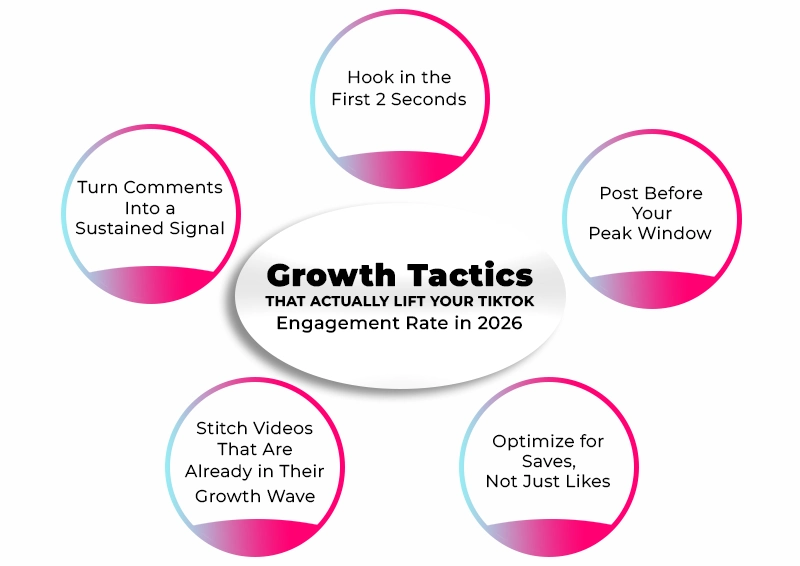
Drop viewers into the middle of something, a reaction, a result, a bold claim, before any context is given. TikTok's 2026 algorithm weights completion rate above almost every other signal, so a slow intro is essentially telling the algorithm to suppress your video. The first two seconds should make scrolling feel like a loss.
Don't post at your peak activity time; post 30 minutes before it. This gives the algorithm time to process and distribute your video so it hits full momentum exactly when your audience is most active. Check your TikTok analytics follower activity graph and use that, not generic "best time to post" guides.
Reply to every comment within the first hour to double your comment count and signal to TikTok that the conversation is alive. Then end your videos with a specific, divisive question, not "what do you think?" but something pointed enough that viewers feel compelled to answer and return.
Find videos that are 24–72 hours old and gaining rapid traction, then add a contrarian take or genuinely valuable response. You borrow momentum from content the algorithm is already pushing hard, pulling your video into the same interest graph distribution.
Saves signal lasting value to the algorithm, not just scroll-stopping novelty. Build content with a "keep this" quality: checklists, frameworks, or tutorials people will want to revisit. High save-rate videos get treated as reference content and keep receiving distribution long after the initial push fades.
TikTok in 2026 has completely shifted what success looks like on the platform. The creators pulling consistent reach right now are the ones who understand how the algorithm thinks and build content that feeds it exactly what it wants. Completion rates, saves, shares, and comment activity are the new currency, and every tactic in this blog ladder up to those signals. The good news is that none of this requires a massive following or a production budget. It requires the patience to let the algorithm reward quality over quantity. Stop optimizing for numbers that do not move the needle, start optimizing for the ones that do, and your TikTok engagement rate will not just improve, it will compound.
A good engagement rate is between 3.85%–4.9% as “good”, while smaller accounts with under 5K followers might land near 4.2% on average.
From what lots of analytics reports show, 100–1K followers can average around 10.5%, then 1K–10K is about 10.57%, and 10K–100K drops to 8.19%.
Engagement drops due to lower content quality, increased brand competition, algorithm changes prioritizing popular content, or potential shadow bans from flagged content.
Yes, when engagement is higher, it tells TikTok that your video should be shown to more people on the For You Page since it seems to reward content that keeps people moving
TikTok’s average engagement rate is around 4.25%, which is roughly 8x higher than Instagram's at 0.98% in 2026.
Engagement can mean likes, comments, saves, and shares. These are the interactions that show people react to.
Brands often want creators sitting in that 3.85%–4.9% band, although top performers frequently go above 10% and keep it there.
Saves and shares are considered the highest engagement signals. Even 5–10 shares per 1,000 views can nudge your engagement rate upward toward that 4%+ “good” zone.
Yes, smaller accounts under 5K followers often achieve 4.2%+ engagement because TikTok's algorithm favors authentic conversations and niche audiences over large, diluted follower bases.
Table of Content

Jordan Calloway
Jordan Calloway is a social media growth strategist with seven years of expertise in TikTok content optimization, monetization, and algorithmic research. Having worked directly with brands and independent creators across the USA and UK, Jordan focuses on strategies that produce measurable results, not vanity metrics. This page reflects both platform research and real-world testing from working inside active TikTok growth campaigns.
If you've been posting on TikTok for months and your follower count looks fine, but your bank accoun...
In 2026, not every post on TikTok is a video anymore. Sometimes, a good TikTok text post can make a...
You’re not going crazy because your follower count hasn’t increased during the past year...
Want to grow on TikTok but don't know how? LikesForYou will help you to give your TikTok the glow it deserves.

NOW ENJOY DISCOUNT ON EVERY PURCHASE
